™

Hearthkin Woods is an online adventure for players in grade 6 and up, where math gets used on real problems instead of drilled on worksheets. A neighbour needs a fence measured, a baker needs an order priced, a fisherman needs to know which catch is ordinary. Your kid works it out, because somebody in the valley is stuck without it.

It's the kind of screen time we'd want for our own kids: they're making decisions, working out how things work, and the game has natural places to stop.

We wanted a game we'd be comfortable handing to a kid without hovering over their shoulder: one where the online part doesn't mean strangers, where nothing is engineered to squeeze money out of a child's impulse control, and where the educational side isn't a thin coat of paint over a slot machine.

This page covers what the game is, what the math looks like, what else your kid practises while playing, how the safety works, and what we haven't figured out yet. Where something is undecided, we say so. Teaching at home? There's a page for homeschool families, and one for teachers.

A different kind of screen time

What they're actually doing while they play

Not all screen time is the same. Scrolling and tapping is one thing. Working out a problem somebody needs solved is another.

Learning for the age of AI

Calculators and AI can already do the sums. The skill that lasts is knowing what to ask and spotting when an answer is wrong. In most quests the game does the arithmetic, and players earn their reward by deciding what needs working out.

Thinking, not tapping

Every errand is a small, real problem: a fair price, a fence length, enough oil for six lanterns. That's abstract thinking and knowing how things work, practised inside a story they care about.

Gamified learning that's actually a game

Nothing stops to quiz anybody. The math is how you get things done, so there's no moment where the game turns into a worksheet and kids start clicking through.

Easy to put down

No streaks, no daily rewards, nothing that withers while they're away. Most evenings end at a natural stopping point, and nothing nags them to stay.

We're not promising better grades or anything about their health. What we mean is that the time goes into thinking rather than scrolling, and ends when they're ready. The research we built on is on the why it works page.
Beyond the math

What else they practise when they play well

A kid who enjoys Hearthkin Woods and gets good at it is doing a lot more than sums. These are the everyday habits the game asks for, because its world doesn't work without them.

Following instructions

Every job comes with its own directions: a recipe card at the lemonade stall, an order to pack "in cartons of eight", a delivery address that reads "up to Street 3, third house on the right". Skip a step and it doesn't work.

Reading carefully

"Enough cartons for every egg" and "only full cartons" need different answers. Quests are short, but every word counts, so players learn to read the whole thing before they act.

Planning ahead

Crops take days to grow, the watering can runs dry, the bag only holds so much, and the farm day ends at bedtime. Players who think a day ahead get more done.

Patience

A pumpkin takes eight days. A companion grows only when it has been fed, played with and taken out. The good things in the game are worth waiting for, and nothing sells a shortcut.

Looking after something

Every player raises a creature companion. It needs feeding, care and time together, and it grows into new forms as the bond grows. It's a small, steady responsibility that is theirs.

Earning, saving and spending

Every coin comes from someone: a job done, a crop sold. Bigger pockets, better tools and farm animals all cost real savings, so players learn to choose what's worth it.

Building things

Players craft their own tables, chests and gates, plan where a fence goes, and set up a farm the way they want it. Raw materials become something useful, one step at a time.

Teamwork and bouncing back

Some fights need a party of three, with shared rewards and a plan. Everyone gets knocked out sometimes. You get up, change something, and try again.

These describe what the game asks of players, not results we've measured. We think they're good habits to practise, and that practice sticks better inside a world a kid cares about.
Safety by design

The risky parts were left out, not moderated away

Filters and moderation queues miss things, so the riskiest features aren't in the game at all.

No typed chat, and no typed names, for anyone

Nobody in Hearthkin Woods can type a message, at any age. Players talk with quick chat: short phrases from a fixed list we wrote, shown in a speech bubble. Pressing Enter opens that list. A friend request carries no note.

Character and companion names are rolled with a dice from names we wrote, so no name can be a real name or a rude word. Anyone can block a player, and a blocked player can't tell.

Play without an account

Press Play free on the website and the game starts. No sign-up, no email address, nothing to fill in. To keep a hero for good, your child can make a username and a password later. There is still no email address.

No real names shown to other players

Other players see a character name inside the game world. Right-clicking a player shows their character and gear, never a username, real name or anything from the account.

No ads, no third-party trackers

There is no advertising in the game and no ad network, analytics broker, or social-media pixel following your child around. Nobody is paying us for their attention or their behaviour data, because we're not selling either.

Accounts hold very little

An account is a username, a password, a birthday check, and the save file for the farm: crops, inventory, quest progress, that sort of thing. No email, phone number or address, no contacts, no microphone or camera access. The game does keep records of each play session (the device, the browser, how smoothly it ran) to fix bugs. If your child joins a teacher's class, we also keep which class, so that teacher can see what they practised. Details are on the privacy page.

The math is real

Arithmetic your kid can't route around

The test we use: if you deleted the math, would the game still work? If yes, the math was decoration. Here it isn't.

Money that forces regrouping

The currency is strictly base ten. Ten bronze coins are worth one silver coin, and ten silver are worth one gold: ones, tens and hundreds. So a price of 556 isn't a number you tap past — it's 5 gold, 5 silver and 6 bronze, and your kid has to compose that out of the coins they're actually carrying. Coins never swap up on their own, so a pocket of loose bronze has to be counted as it is.

Pay too little and the shopkeeper doesn't hand anything over; pay a little too much and they keep it as a tip. It's place value with consequences, which is a very different experience from a worksheet column.

Place value Regrouping Counting money
Bronze1 poro
Silver10 bronze
Gold10 silver
The game's own coins. Each one is worth ten of the one before.

Quests that need the answer

A restaurant's books need balancing — money in on one side, money out on the other, and the totals have to agree. Eggs have to be packed into cartons of six, eight, ten or twelve before they ship. A fence needs measuring before you can cut the wood for it. Chickens have to be weighed and compared, which means comparing numbers rather than eyeballing them.

Later on, a lamplighter has exactly enough oil for six lanterns, each three-quarters full. A baker's pies have to be cut into the slices each customer ordered. A fisherman swears every catch is a big one, and the numbers decide whether he's right.

Further in, the math climbs to the grade 6 and 7 level. A farmer's buyers bid "4 baskets for 36 poro", so the best price per basket wins. A shopkeeper's prices have to be worked out from a pile of old bills. A 10% tax has to be covered, and a hen's weight change can go below zero.

Every one of these is a job somebody in the valley needs done. Kids do the math because a character they like is stuck without it. In most quests the game does the long sums; the player decides what needs working out, which is the part that matters.

Debits & credits Packing in groups Measurement Comparison Fractions Unit prices Negative numbers Equations The median Percent
What we're not claiming. Forty-three quests use math we've matched to the Common Core standards. The early ones lay the foundations (counting, measuring, fractions, multiplying) and the later ones reach grade 6 and 7. We're not claiming results, and we don't send you a progress report yet. It's a game that needs real math to play well.
Where it's going

Next: the money sense most of us learned the hard way

The math is where it starts. The valley is being built to run the way the real world does, so the further your kid goes, the more of grown-up life they get to try: earning a wage, budgeting it, saving for something big, borrowing and paying back, and running a small business. A wrong call costs game coins and teaches something, years before the same mistake would cost real money.

Those arrive a layer at a time. Today's game has the jobs, the coins, the shops and the market stall; the rest is what we're building next, and we'll only say it's in the game once it is.

What we collect

In plain English

  • A username and a password — that's the account. Sign-in is handled by Google Firebase Authentication, and passwords are stored by them, not by us in readable form.
  • A birthday check — asked once at sign-up. We don't keep the birthday. For a player under 13 we keep only the date they turn 13, and we keep nothing for anyone else.
  • Or no account at all — Play free starts the game with nothing filled in. The hero is saved on that browser until your child makes a username and password.
  • Gameplay save data — the farm, inventory, quest progress, character appearance, pet. The things that need to still be there tomorrow.
  • A class, if they join one — a teacher can give students a class code. We keep which class your child joined. Their teacher sees their username, their heroes and which math quests they practised, and nothing else. We never store your child's real name, and they can leave the class at any time.
  • Nothing else. No advertising identifiers, no contacts, no location, no microphone or camera. Data isn't sold or handed to advertisers.
  • You can have it deleted. Email the support address and the account and its save data go away.

The full detail — where it's stored, how long it's kept, how to ask for deletion — is on the privacy page.

Questions

Questions parents ask

Is this a real game, or homework in disguise?

A real game. It's an online world with eight hero classes to pick from, a companion creature that fights beside you and grows into new forms, a story to follow, cartoon battles and bosses, a farm you keep, and parties to play with friends. Kids play it the way they'd play any adventure game.

The difference is that the systems underneath — money, packing, measuring — are built out of actual arithmetic instead of pretend numbers. Nothing pauses the game to quiz anyone.

Can my kid talk to strangers?

No. Nobody in the game can type a message, at any age. Players talk only with short phrases from a fixed list we wrote, and any player can be blocked.

They will see other players around the world, and they can play near them. Nobody can write to them in their own words.

How much does it cost?

We haven't decided yet, and we'd rather say that than invent an answer. What we can commit to now is what it won't be paid for with: no advertising, no loot boxes, no randomised rewards, and no mechanics that pressure a child into spending to keep up with other players. And you won't be able to buy the answer: nothing for sale will ever get a player past a puzzle.

Whatever the model ends up being, it will be something a parent decides once — not something a kid gets nudged toward at a checkout screen.

Who is it for?

Players in grade 6 and up, so about age 11 onwards. The problems start simple and get harder the further they go. Every player gets the same safe game: no typed chat and names from our lists, as described above. The terms and the privacy page have the details.

We never ask your child for a real name, email address, home address, phone number or photo. Their account is a username and a password, nothing more.

Beyond that: it suits players who like calm, building-things games more than fast reflex ones. If a kid enjoys tending a farm and running errands for villagers, they'll get on with it.
Can we use it for homeschool, or in a class?

Yes. Homeschool families have their own page, with ways to use it beside lessons and questions to ask after they play: for homeschool. Teachers can read how it fits a classroom on the for teachers page.

Can I play it too?

Yes. Plenty of our testers have been adults. It's a full adventure you need your head to beat, and the problems get harder as you go, so it works as a way to keep your own skills sharp, or to play alongside your kid.

Who makes it?

Sahai Interactive Inc. There's no publisher behind it, no ad partner, and nobody paying for your child's attention.

If you want to know why something is built the way it is, write in and we'll explain it.

Is any of it made with AI?

Some of it, and the game says so the first time you open it. Most of what you see in the game was made by real artists. To bring the world to life sooner, we used AI for some props, item icons, sounds and character voices, and for the pictures on this website.

The plan is for all of the game's art, sounds and voices to come from real artists.

What devices does it run on?

It plays in a web browser — nothing to install, nothing to download, no app store account required. That also means no background software sitting on the family computer.

It's built for a keyboard and mouse on a laptop or desktop. Tablets and phones aren't supported yet.

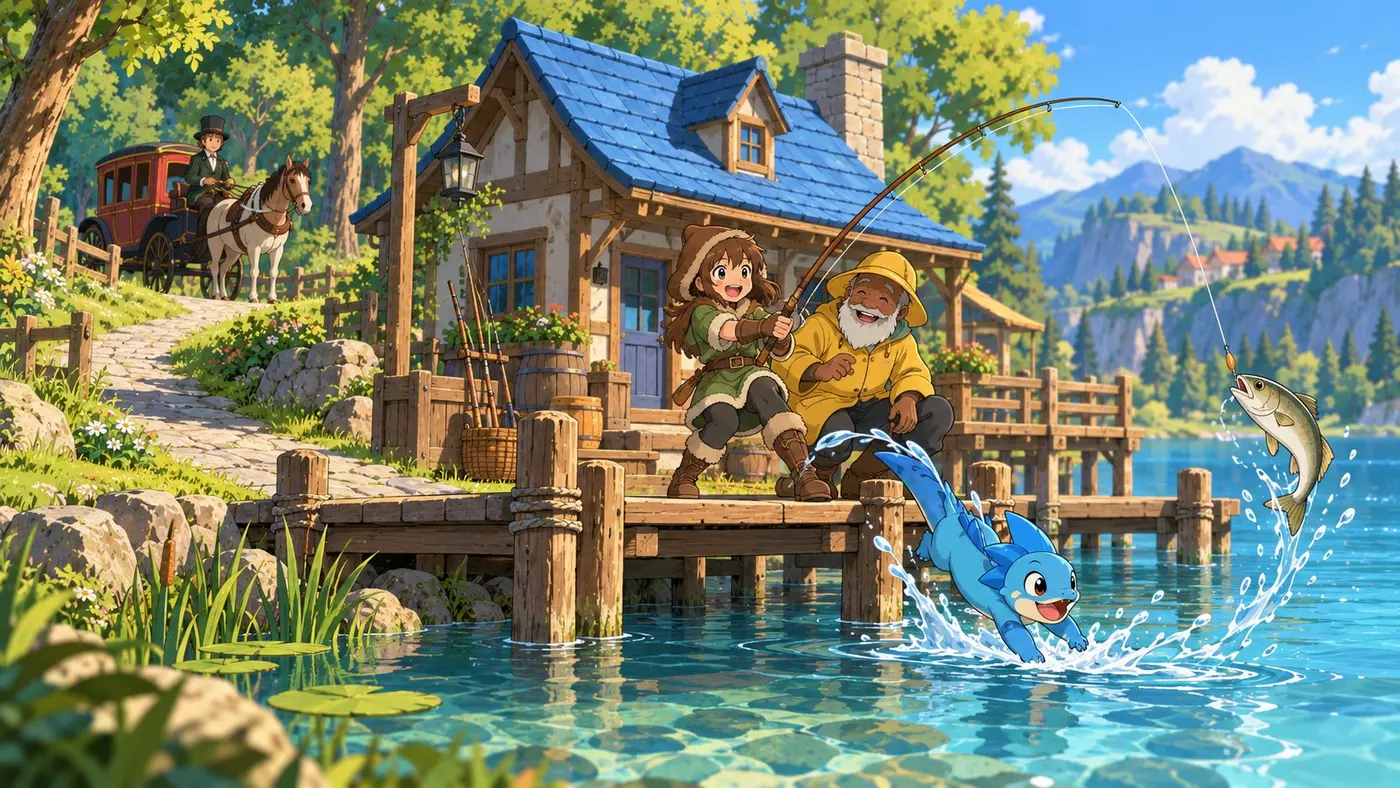
A young hero and an old fisherman sharing a fishing rod on a lakeside pier, a blue water creature leaping after the fish they've hooked, a horse and coach on the lane behind.

Take a look before they do

It runs in the browser, so you can open it yourself and have a wander around the farm first. That's usually the fastest way to judge it.